

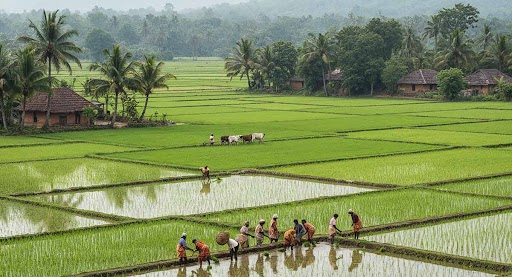
Understanding Rice Production in Odisha
Located on India’s east coast, Odisha is well-known for its temples, rich cultural legacy, and natural beauty, but it also plays an integral part in the country’s rice production. Odisha has long played a significant role in cultivating rice, the primary diet of most of its people, thanks to its fertile plains, copious rainfall, and sizable agrarian population. This blog examines the importance, practices, challenges, and prospects of rice production in Odisha.
Importance of Rice in Odisha
Rice is not just a crop in Odisha but a way of life. Over 76% of the state’s cultivated land is devoted to rice farming, making it the most widely grown crop in Odisha. It is central to the state’s food security and rural economy. Odisha’s economy is predominantly agrarian, with nearly 60% of the workforce engaged in agriculture, and rice farming supports millions of these families, directly or indirectly.
Regarding dietary preferences, rice is a staple in almost every household in Odisha. Whether it’s a festive meal like Pakhala Bhata (fermented rice), aromatic rice dishes like Kanika, or everyday plain rice with dal and vegetables, this grain dominates Odia cuisine.
Agro-Climatic Advantage
The favorable agro-climatic conditions of Odisha suit rice cultivation perfectly. The state has diverse ecosystems ranging from coastal plains to plateaus and hilly regions. Most regions receive ample rainfall during the monsoon season (June to September), crucial for paddy cultivation. Water availability from rivers like Mahanadi, Subarnarekha, and Brahmani further increases the state’s irrigation potential.
The state supports multiple cropping patterns, including:
- Kharif season (monsoon crop): The primary season for rice, accounting for about 85% of the total production.
- Rabi season (winter crop): Cultivated in irrigated areas with residual moisture.
- Summer rice: Grown in pockets with access to irrigation, especially in the coastal belt.
Major Rice Growing Districts
Some of the prominent rice-producing districts in Odisha include:
- Sambalpur
- Bargarh
- Kalahandi
- Balasore
- Cuttack
- Koraput
- Mayurbhanj
Among these, Bargarh is often called the “Rice Bowl of Odisha” due to its large-scale paddy cultivation and relatively higher productivity.
Varieties Grown
Odisha is home to high-yielding and traditional rice varieties (HYVs). Several high-yielding, disease-resistant varieties appropriate for the state’s agroclimatic zones have been produced by the Central Rice Research Institute (CRRI) in Cuttack and the Odisha University of Agriculture and Technology.
Some popular rice varieties cultivated in Odisha include:
- Swarna
- Lalat
- MTU-1010
- Jagannath
- Naveen
The state also takes pride in growing indigenous aromatic and heirloom varieties like Kalajeera (black cumin rice) and Khandagiri, which people often prefer for their unique taste and medicinal properties.
Role of Technology and Government Initiatives
To improve productivity and farmers’ income, the government of Odisha has implemented several initiatives:
- Promotion of System of Rice Intensification (SRI)
SRI is a technique that improves yields through better spacing, water management, and organic fertilization. Many farmers in Odisha have adopted this method with the support of agricultural extension programs.
- Mechanization and Farm Equipment Distribution
The state promotes mechanization by subsidizing tractors, power tillers, and rice transplanters. This reduces labor dependency and increases efficiency.
- Irrigation Projects
Schemes like Biju Krushak Vikas Yojana (BKVY) and Jal Nidhi have helped expand irrigation infrastructure, especially for Rabi and summer rice crops.
- Direct Benefit Transfers (DBT)
Fertilizer and seed subsidies are now offered through DBT, reducing corruption and improving access for small and marginal farmers.
- Procurement and MSP
The Odisha State Civil Supplies Corporation (OSCSC) purchases paddy at the Minimum Support Price (MSP) to provide a safety net for farmers.
Challenges in Rice Production
Despite its strengths, rice production in Odisha faces several challenges:
- Climate Variability: Erratic rainfall, floods, and droughts often impact yield and cropping patterns.
- Post-Harvest Losses: Poor storage infrastructure and lack of processing facilities lead to high post-harvest losses.
- Low Market Linkages: Many farmers depend on middlemen, reducing their profit margins.
- Fragmented Land Holdings: Small land parcels hinder mechanization and scalability.
- Input Cost Fluctuation: Rising fertilizers, diesel, and labor prices can erode profitability.
Final Thoughts
Rice production in Odisha is deeply woven into the state’s identity, economy, and food culture. While it has made significant progress over the years regarding area and productivity, it still faces multiple challenges that require policy attention, innovation, and sustainable practices. With a balanced focus on technology, tradition, and ecology, Odisha has the potential to feed its people and become a model of inclusive and sustainable rice farming for the rest of India.