

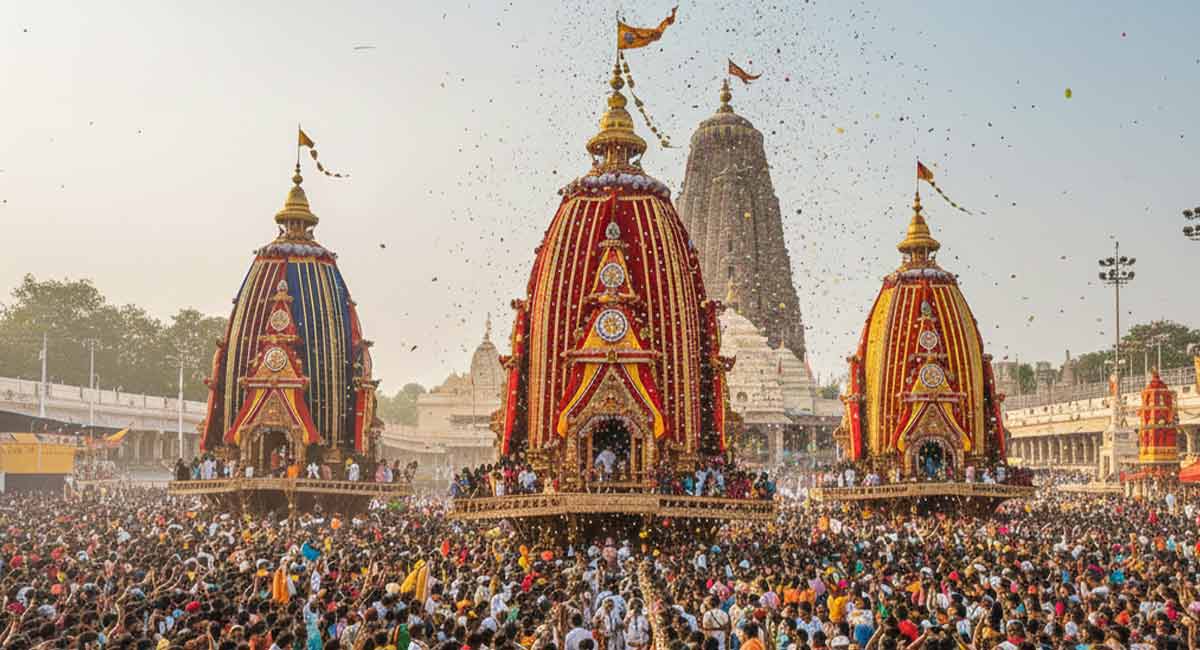
Mystery of Nabakalebara
The magnificent Jagannath Temple, home to Lord Jagannath, the Lord of the Universe, is in the center of the historic city of Puri, Odisha. The temple is one of India’s most revered pilgrimage sites, with intricate carvings, vibrant festivals, and centuries-old rituals. However, a mysterious and fascinating event happens once every 12 to 19 years, which intrigues scholars, devotees, and mystics alike. This event is called Nabakalebara — a sacred and mystical process of the “rebirth” of Lord Jagannath.
What is Nabakalebara?
Nabakalebara is an ancient and sacred tradition in the Jagannath cult. It involves the replacement of the current wooden idols of Lord Jagannath, his brother Balabhadra, and their sister Subhadra, with new ones. The term “Nabakalebara” is derived from two words in Sanskrit: “Naba,” meaning new, and “Kalebara,” meaning body or form. It symbolizes the process of divine transformation and renewal of the deities.
The temple authorities perform the Nabakalebara only when they find that the current idols, made of a special type of wood called Daru (a neem wood), are worn out and no longer suitable for worship. A special group of sculptors known as the Rathakaras carefully carve the new idols, following strict religious guidelines passed down through generations. The priests ceremoniously install the new idols in the temple and ritually bury the old idols with great reverence.
Mystical Significance of Nabakalebara
The concept of Nabakalebara goes beyond just a physical replacement of wooden idols. It is deeply rooted in the spiritual and metaphysical beliefs of the devotees. The process signifies the concept of rebirth and the renewal of life. In Hindu philosophy, the cycle of birth, death, and rebirth is ongoing. Lord Jagannath undergoes this cycle as a manifestation of the Supreme Being, a symbol of the eternal nature of existence.
“The mysterious aspect of Nabakalebara lies in how the priests and temple officials choose the new idols. According to tradition, they must carve the idol of Lord Jagannath from a specific tree, often called the ‘Banayan tree.’ They believe that divine forces chose this tree, and they searched with great secrecy and ritual. Once they locate the tree, they ceremonially cut it down through a sacred ritual that ensures its spiritual purity. The priests and high-ranking temple officials guide the entire process and claim to feel Lord Jagannath’s divine energy during the transformation.
The carving of the idols is also a mysterious and almost sacred art. The sculptors, known for their extraordinary skills, follow precise methods and instructions in ancient texts to carve the idols. The artisans carve the idols so that their eyes, particularly the eyes of Lord Jagannath, always appear wide open, symbolizing his ever-watchful gaze on the world.
Rituals of Nabakalebara
The rituals accompanying the Nabakalebara ceremony are incredibly complex and conducted with meticulous attention to detail. The event begins with the Ratha Yatra (Chariot Festival) in Puri, during which the temple priests temporarily remove the deities from the temple. During this time, they removed the old idols and placed the new idols in the temple after performing various rites and ceremonies.
One of the most fascinating parts of Nabakalebara is the ‘Nava Kalebara’ ritual, where the priests bury the old idols with due reverence. They take the idols to a secret location and ritually inter them in a specially prepared spot. The priests bury the idols with great care and precision and keep the burial place secret to maintain the sanctity of the process.
Moreover, a special ritual known as ‘The Ratna Bedi’ takes place, where the priests place the new idols on the altar and transfer the sacred symbols of the deities, such as their ornaments and garlands, from the old idols to the new ones. This is an essential moment for devotees, as they believe that Lord Jagannath is reborn and once again takes his place as the ruler of the Universe.
Mystery Behind the Timing
One of the most enigmatic aspects of Nabakalebara is the unpredictability of its timing. At the same time, astrologers generally determine the exact year of its occurrence, every 12 to 19 years, based on a complex set of astrological calculations. The Hindu lunisolar calendar determines the date of Nabakalebara, and the event occurs only when certain conditions align, such as the specific positions of the moon and other celestial bodies.
Interestingly, this timing creates an aura of anticipation and excitement among the devotees. Pilgrims eagerly await the announcement of Nabakalebara, as many see it as a once-in-a-lifetime event. The festival draws millions of visitors to Puri, making it a spiritual and cultural phenomenon that resonates far beyond the city.
Final Thoughts
Nabakalebara is a significant spiritual event representing the endless cycle of life, death, and rebirth. It goes beyond simply physically replacing idols. It reminds us of life’s impermanence and the divine’s infinite nature. The mystique surrounding the event continues to captivate the imagination of devotees, ensuring that the tradition of Nabakalebara will remain an essential part of India’s cultural and spiritual heritage for generations to come.